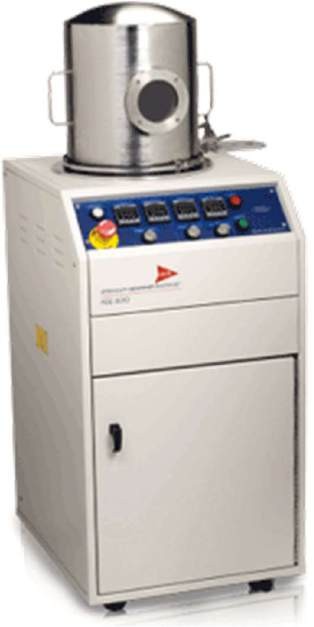
Parylene CVD Deposition System
Parylene Coating Deposition Machine
Chemical Vapour Deposition system for conformal parylene coatings
Our parylene coating machine uses chemical vapour deposition (CVD) to deposit parylene polymer films at molecular level from the vapour phase. The process occurs at room temperature, ensuring zero thermal stress on delicate substrates. The coating penetrates all crevices, voids, and component geometries uniformly — impossible with spray or dip coating methods.
Chamber Size200L / 400L / 600L
Deposit TempRoom Temp (~25°C)
Pyrolysis Temp~680°C
Vaporiser Temp150°C – 200°C
Vacuum Level< 0.1 mTorr
Coat Thickness0.1 μm – 100 μm
Rate0.2 – 0.5 μm/hr
ControlPLC + Touchscreen HMI
Cold Trap-90°C LN₂ cooled
- True 100% conformal coverage
- Pinhole-free coating
- Room-temperature deposition
- Coating thickness monitor
- Auto process recipe storage
- Safety interlock system
- Cold trap efficiency >99%
- Batch or continuous loading
Supported Parylene Types
The system is compatible with all major parylene variants, each offering distinct performance characteristics for different application requirements.
| Type | Key Properties | Best Applications | Thickness Range |
|---|---|---|---|
| Parylene N | Lowest dielectric constant, highest penetrating power | High-frequency electronics, capacitors | 0.5 – 25 μm |
| Parylene C | Best moisture/chemical barrier, most widely used | PCBs, medical devices, automotive | 0.5 – 50 μm |
| Parylene D | High-temp stability, good mechanical strength | Aerospace, defence electronics | 1 – 50 μm |
| Parylene HT | Excellent UV & thermal resistance up to 450°C | Harsh environments, optics, MEMS | 0.1 – 25 μm |
| Parylene AF-4 | Chemically inert, superhydrophobic | Lab-on-chip, microfluidics, implants | 0.1 – 10 μm |
Application Areas
PCB & Electronics
Medical Devices
Aerospace
Automotive
MEMS & Sensors
Lab-on-Chip
CVD Deposition Process
- Loading: Parts are fixtured and masked in the deposition chamber. The chamber is sealed and pumped down to high vacuum (<0.1 mTorr).
- Vaporisation: Solid dimer (di-para-xylylene) is heated in the vaporiser (150–200°C) to produce a gaseous dimer vapour.
- Pyrolysis: Vapour enters the pyrolysis furnace at ~680°C, cleaving the dimer into reactive monomer radicals (para-xylylene).
- Deposition: Reactive monomers enter the room-temperature deposition chamber and spontaneously polymerise on all exposed surfaces, forming a uniform parylene film.
- Cold Trap: Excess monomer is captured in the liquid-nitrogen cold trap (−90°C) to protect the vacuum pump and prevent atmospheric release.
- Unloading & QC: After process completion, the chamber is vented, parts are unloaded, and coating thickness verified by in-process quartz crystal monitor.